
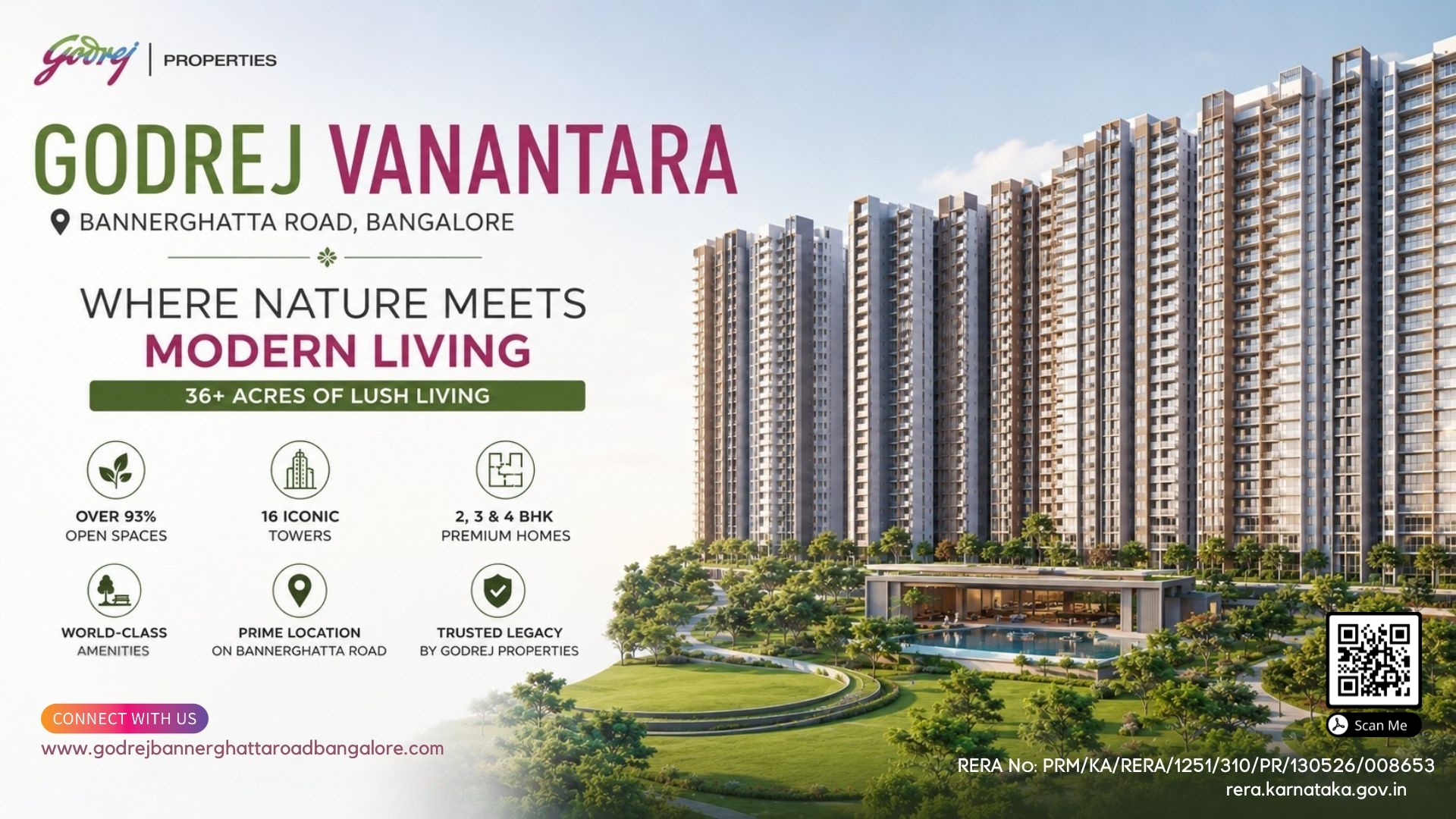
The Godrej project at Bannerghatta Road Bangalore has started generating a very different kind of discussion across South Bangalore property circles. Most apartment launches usually enter the market with predictable marketing language around amenities, luxury branding, and tower elevations. The early reactions surrounding this development however feel much more serious among investors, channel partners, land consultants, and long-term homebuyers who actively track large-scale residential planning in Bangalore.
The reason becomes clearer after studying the recently available project filings and development structure.
Several builders continue launching vertical apartment clusters across Bangalore every quarter. A much smaller number actually attempt township-scale planning with controlled density, large open allocations, and infrastructure-backed execution capacity. Godrej Vanantara appears to belong to the second category.
My conversations with broker networks operating around Bannerghatta Road, Begur, Hulimavu, and Akshayanagar reveal growing interest toward projects that provide long-term livability instead of simply maximizing tower count inside compact land parcels. Buyers increasingly evaluate projects through a very different lens now. Questions around movement comfort, privacy, ventilation, parking planning, open circulation, and community scale matter far more than they did a few years ago.
The newly available RERA details registered under Karnataka RERA No. PRM/KA/RERA/1251/310/PR/130526/008653 now provide a much deeper understanding regarding what Godrej Properties is actually planning here.
Bannerghatta Road No Longer Functions Like An Outer Residential Belt
Many people outside Bangalore still misunderstand Bannerghatta Road.
Older perceptions associated this corridor primarily with scattered residential pockets and gradual suburban growth. The present reality looks significantly different. Infrastructure expansion, office connectivity, educational institutions, retail growth, and expanding residential demand have transformed the region into one of the more strategically watched residential belts in South Bangalore.
The project location inside Hommadevanahalli Village near Begur Hobli places Godrej Vanantara within an emerging stretch that increasingly attracts both end-users and investors searching for long-term urban expansion potential.
Several factors contribute to this shift:
- Growing pressure on central Bangalore housing supply
- Rising preference for larger community-style developments
- Better road connectivity toward Electronic City and ORR influence zones
- Expanding social infrastructure
- Demand for less congested residential layouts
The psychological shift among premium buyers has become very visible.
Luxury buyers earlier prioritized city-center pin codes almost exclusively. Modern buyers increasingly evaluate overall quality of life. Congestion fatigue has started affecting decision-making heavily. Wide internal roads, green movement areas, open sightlines, and breathing space now influence premium purchase behavior much more strongly.
That transition directly supports developments like Godrej Vanantara.
A 36-Acre Residential Layout Changes Buyer Expectations Completely
The biggest differentiator visible inside the filings is the sheer development scale.
The project spans approximately 146,229 square meters, translating to around 35 acres.
Large plotted residential developments have become increasingly difficult inside Bangalore because land fragmentation continues accelerating across major corridors. Many apartment launches today operate on much smaller parcels where construction density becomes extremely aggressive.
Godrej Vanantara moves in the opposite direction.
The filings indicate:
- Total open area: 136,240 sq m
- Covered ground area: only 9,989 sq m
That ratio immediately stands out.
Very few large apartment developments currently entering Bangalore allocate such a substantial percentage toward open surroundings. Several experienced investors I spoke with specifically pointed toward this aspect because future resale demand increasingly favors projects that avoid overcrowded internal planning.
The emotional experience inside a residential township matters much more than brochures suggest.
Daily life inside dense projects eventually creates:
- Lift congestion
- Parking movement delays
- Crowded clubhouse usage
- Poor ventilation between towers
- Reduced privacy
- Limited greenery visibility
Projects with larger land utilization generally age better over time because the overall living experience remains sustainable even after years of occupancy.
That long-term factor increasingly drives serious investor interest.
The Tower Planning Reveals A Different Density Strategy
The project proposes 16 towers with 2008 apartments.
At first glance, 2000+ units may appear large. The actual density however looks relatively balanced after evaluating the land parcel size and FAR structure.
The sanctioned FAR stands at 1.999.
That number matters.
Several modern Bangalore apartment developments push FAR utilization much more aggressively. Lower FAR utilization generally creates:
- Better spacing between structures
- Wider internal circulation
- Improved sunlight penetration
- Enhanced ventilation
- Better landscape visibility
- Reduced visual crowding
One of the sample towers visible in the filing illustrates this approach clearly.
Tower A includes:
- 30 floors
- 122 apartments
- 3 basement levels
- Approximate height of 95.4 meters
Most upper floors contain only four apartments per level.
That arrangement generally supports stronger privacy planning compared to towers carrying 8-12 units per floor. Families increasingly notice this difference during actual occupancy because lower floor density changes the everyday living experience significantly.
Godrej Properties Appears To Be Prioritizing Family Housing Instead Of Compact Investor Stock
The apartment mix inside the filings provides another important clue regarding project positioning.
Inventory breakdown includes:
- 562 units of 2 BHK
- 1314 units of 3 BHK
- 132 units of 4 BHK + Maid rooms
The dominance of 3 BHK inventory becomes extremely important here.
Many builders aggressively increase compact apartment supply because smaller units improve inventory turnover. Godrej Vanantara instead appears heavily focused toward family-oriented layouts.
That approach aligns with broader Bangalore housing demand trends.
Post-pandemic residential behavior changed substantially:
- Work-from-home requirements increased
- Children spend more time inside communities
- Wellness-oriented living became important
- Buyers started preferring long-term usable layouts
- Apartment selection moved beyond pure affordability
Several premium buyers now specifically reject ultra-compact floor plans even when pricing looks attractive.
The sample carpet sizes reinforce this positioning:
- 2 BHK units around 833-887 sq ft
- 3 BHK units around 1300+ sq ft carpet area
These are practical family dimensions rather than aggressively compressed layouts designed only for pricing optics.
Why Open Space Has Become More Valuable Than Clubhouse Marketing
One interesting shift happening across Bangalore residential markets involves buyer psychology toward amenities.
Earlier apartment launches depended heavily on flashy clubhouse presentations and promotional recreational features. Current buyers increasingly ask deeper questions:
- How much actual walking space exists?
- How crowded will common areas become?
- Are towers too close together?
- Can children use outdoor spaces comfortably?
- Will internal roads feel congested after full occupancy?
Open land therefore now carries far greater emotional and financial value.
The project filings suggest that Godrej Vanantara may attempt positioning itself around large landscaped surroundings instead of only amenity-heavy vertical construction.
That distinction matters enormously for future resale perception.
Projects with stronger open planning usually maintain:
- Better long-term visual appeal
- Higher premium positioning
- Stronger family retention
- Better rental attractiveness
- Reduced community fatigue
This becomes particularly relevant in Bangalore where residential density continues increasing rapidly.
Parking Planning Often Reveals The Actual Intent Of A Township
Parking data inside RERA documents often exposes whether a project is genuinely designed for long-term usability.
Godrej Vanantara project at Bannerghatta Road Bangalore includes:
- 2153 covered parking spaces
- 201 open parking spaces
That creates approximately 2354 total parking spaces against 2008 apartments.
This ratio appears relatively balanced for a large family-oriented development.
Several crowded apartment projects later face severe parking stress because early planning underestimated future multi-car ownership patterns among premium families. Better parking allocation generally indicates stronger long-term operational planning.
Three basement levels inside Tower A also support this interpretation.
Construction Cost Commitment Suggests Aggressive Development Intent
Another major detail visible in the registered RERA filing involves the total project expenditure.
Declared project cost:
- Approximately ₹2626 crore
Layout development cost alone exceeds ₹2173 crore.
That distinction matters more than many buyers realize.
When infrastructure allocation becomes substantially larger than raw land cost, it usually indicates:
- Heavy internal development planning
- Extensive structural investment
- Large-scale landscaping
- Premium community infrastructure
- Long-duration township execution
Several experienced investors track this ratio carefully because underfunded infrastructure often becomes visible later during project execution.
The financial structure visible here appears far more ambitious than conventional mid-sized apartment launches.
The Timeline Suggests A Multi-Phase Execution Vision
According to Karnataka RERA registration number PRM/KA/RERA/1251/310/PR/130526/008653, the official completion timeline currently extends until May 2031.
Some buyers interpret longer timelines negatively. Large township projects however function differently from compact single-tower developments.
Massive residential layouts usually require:
- Infrastructure sequencing
- Utility integration
- Landscape development
- Internal road systems
- Amenity construction
- Phased possession planning
The timeline therefore reflects development scale rather than construction weakness.
Several of Bangalore most successful long-term residential communities followed similar multi-year execution patterns because township-style planning naturally evolves in phases.
Bannerghatta Road Luxury Demand Is Becoming More Sophisticated
The premium Bangalore buyer has evolved rapidly during the last five years.
Price alone no longer dominates purchase behavior inside upper-mid and premium segments. Families increasingly evaluate:
- Daily movement quality
- Mental comfort
- Community crowding
- Wellness environment
- Green visibility
- Privacy layers
- Tower spacing
- Long-term resale durability
This change explains why projects with stronger planning fundamentals now attract significantly more attention even before formal launch momentum fully develops.
Godrej Vanantara appears positioned directly inside this evolving buyer psychology.
The combination of:
- large land parcel
- lower FAR intensity
- balanced tower planning
- stronger family inventory mix
- high open-space allocation
- major infrastructure expenditure
creates a very different market narrative compared to conventional apartment launches.
Why Investors Are Watching This Development Closely
Several investor groups operating around South Bangalore appear increasingly interested in the project for reasons extending beyond immediate launch pricing.
The broader thesis revolves around long-term urban transition.
Bannerghatta Road continues gradually moving from fragmented suburban growth toward more structured urban residential integration. Large branded township developments entering such corridors often reshape future micro-market positioning entirely.
The long-term investment logic generally revolves around:
- organized infrastructure growth
- premium buyer migration
- township scarcity
- future land replacement difficulty
- lifestyle-driven demand expansion
Large plotted developments become increasingly difficult to replicate once surrounding urbanization intensifies.
That scarcity factor often strengthens long-term value perception.
Water Dependency Still Remains One Area Buyers Will Watch Carefully
One practical detail inside the filings mentions water tanker dependency as the current declared source.
This remains common across several expanding Bangalore residential corridors. Buyers however increasingly monitor water sustainability very carefully now.
Future execution quality around:
- water management
- recycling systems
- storage infrastructure
- long-term sourcing integration
will likely influence final buyer confidence significantly.
Large township communities generally possess stronger capability to build integrated water systems compared to compact standalone towers. Actual implementation however becomes the key factor.
The Current Market Mood Around Godrej Vanantara Feels Different
After studying multiple South Bangalore launches during recent years, one pattern becomes very clear.
Most apartment projects enter conversations briefly and disappear after initial marketing momentum slows. A much smaller number continue generating sustained interest because the underlying planning structure itself creates long-term curiosity among buyers and investors.
The Godrej Vanantara project at Bannerghatta Road, Bangalore currently appears to fall inside the second category.
The discussions surrounding this project increasingly focus on:
- township scale
- density management
- long-term livability
- open-space planning
- future appreciation potential
- premium family positioning
instead of only launch pricing or promotional campaigns.
That shift itself says a lot about how Bangalore residential markets are evolving.
Several experienced property observers now believe future demand growth may increasingly favor developments capable of combining vertical urban convenience with township-style breathing space. Projects that fail to balance these two elements may struggle to maintain premium positioning over longer holding cycles.
This new launch Godrej project at Bannerghatta Road, Bangalore appears designed with that changing market reality in mind.
Leave a Reply